In the past, companies focused on answering a single question: "How can I rank on Google?"
Today, there's another question that's just as important: "How can I be considered an AI-trusted source?"
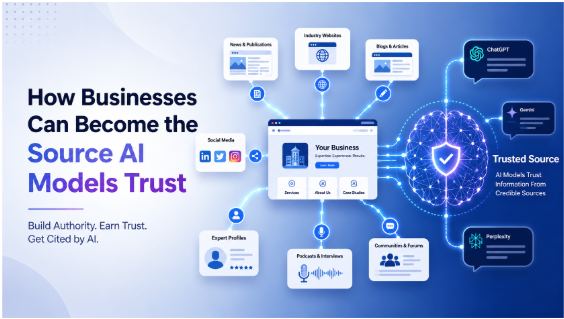
When a person uses ChatGPT, Gemini, Claude, or Perplexity to seek a recommendation, the algorithm does not show them ten blue links. Instead, the algorithms use information from trusted sources to form their responses.
It is a completely different approach.
Companies whose names regularly feature in AI responses are not always those who spend the most money on advertising. Instead, these companies earn their reputation by becoming an authority and credible voice in their area of expertise.
Having worked for more than a decade in the sphere of SEO and Digital PR, I came to the conclusion that there is no need to develop any new skill set to become an AI-trusted source.
Trust Is Built Long Before AI Finds You
People often believe that AI algorithms "find" websites the way users find them. Not quite.
AI algorithms use signals obtained all over the internet. Your site is just one of the pieces of the puzzle.
The more often your company is mentioned in credible sources, quoted by experts, written about in credible websites, and keeps publishing quality content, the more signals it will have to be trustworthy.
AI does not take your word for it that you are a credible source. AI is more likely to trust businesses that the wider web consistently recognizes as credible.
Your Website Is Still Your Strongest Asset
I have heard people saying websites are getting less importance due to the direct responses from AI to questions. This could not be further from the truth.
That is where your expertise resides. This is where AI will get to know about what you do, who you help, services offered, and experience behind your suggestions.
A good website with proper navigation, service pages, an authors page, and latest updates is bound to impress any search engine and AI system. Otherwise, it would be tough for any AI system to understand you.
Publish What You Know, Not What Everyone Else Is Writing
The same mistake I keep coming across time and again is when businesses create content that is exactly the same as all the other websites out there. A generic article does not inspire any trust.
When fifty different websites write "10 Ways to Improve Your SEO," what makes AI choose one article over the other?
Tell us about your experience. Talk about some of the projects you have handled. Speak about the mistakes that you have made. Tell us the strategies that have worked for you and the ones that have failed.
Consistency Matters More Than Volume
Publishing twenty articles in one month will not immediately turn your business into an authority. Publishing one useful article per week over one year probably will.
Authority compounds over time. Each article improves your topic expertise. Each update demonstrates your currency of knowledge. Each useful tool gives another site incentive to cite your work.
Consistency is underrated due to its delayed effects. But it's one of the best trust-building methods.
Digital PR Is No Longer Optional
One of the most significant shifts I have observed in the recent past is the importance of brand mentions. Being mentioned in trusted sources, providing expert opinions, being interviewed, and contributing guest posts all help to increase your digital footprint.
Every reputable mention adds up to the fact that your brand exists beyond your website. That's important because AI pulls signals from many different sources when evaluating the information.
If your expertise is mentioned only on your own website, then your authority will be quite low. However, if industry sources, news sites, blogs, podcasts, and professional communities also refer to you, your credibility is greatly increased.
Digital PR is not only about acquiring backlinks anymore.
Make It Easy to Verify Who You Are
Transparency builds trust. Make sure that you show who has written the content. Include an author bio. Show readers why you're qualified to write about the topic.
Always keep your contact information up-to-date. Connect your social media profiles if applicable. Be an active user on business-oriented websites.
The easier it will be for humans and machines alike to identify you, the higher your credibility rating will be. Such elementary mistakes often get overlooked by businesses.
Focus on Being Useful
Algorithms shift. AI gets better. Ranks shift. There is one thing that doesn't shift. Value stays.
Every article should answer a real question. Every guide should solve a genuine problem. Every reader should leave knowing something they didn't know before.
When value is your focus, trust will come naturally.
Trust Can't Be Automated
AI can provide suggestions. It can help with organization. It can enhance efficiency. However, trust will always be based on humans.
It is based on experience. It is based on expertise. It is based on continually demonstrating genuine expertise.
A business which wants a shortcut usually ends up making more noise. A business which cares about being an authority builds something that will work for many years to come.
This is the difference between creating content and becoming a trustworthy source of information.
As AI becomes increasingly important in the way people learn about businesses, it is not necessary to follow every single algorithm.
The businesses that will succeed in AI search won't be the ones chasing every algorithm update. They'll be the ones that spend years earning trust. Because when your reputation is strong enough, it doesn't matter whether someone searches on Google, asks ChatGPT, or uses the next AI assistant. Your business will already be one of the sources worth citing.